> For the complete documentation index, see [llms.txt](https://docs.empe.io/llms.txt). Markdown versions of documentation pages are available by appending `.md` to page URLs; this page is available as [Markdown](https://docs.empe.io/develop/intro/create_issuer.md).
# Creating a Deployment
A One-Click deployment provisions a complete SSI stack behind one hosted domain — an **Issuer** API (OpenID4VCI), a **Verifier** API (OpenID4VP), and a **wallet server** for cloud-held credentials.
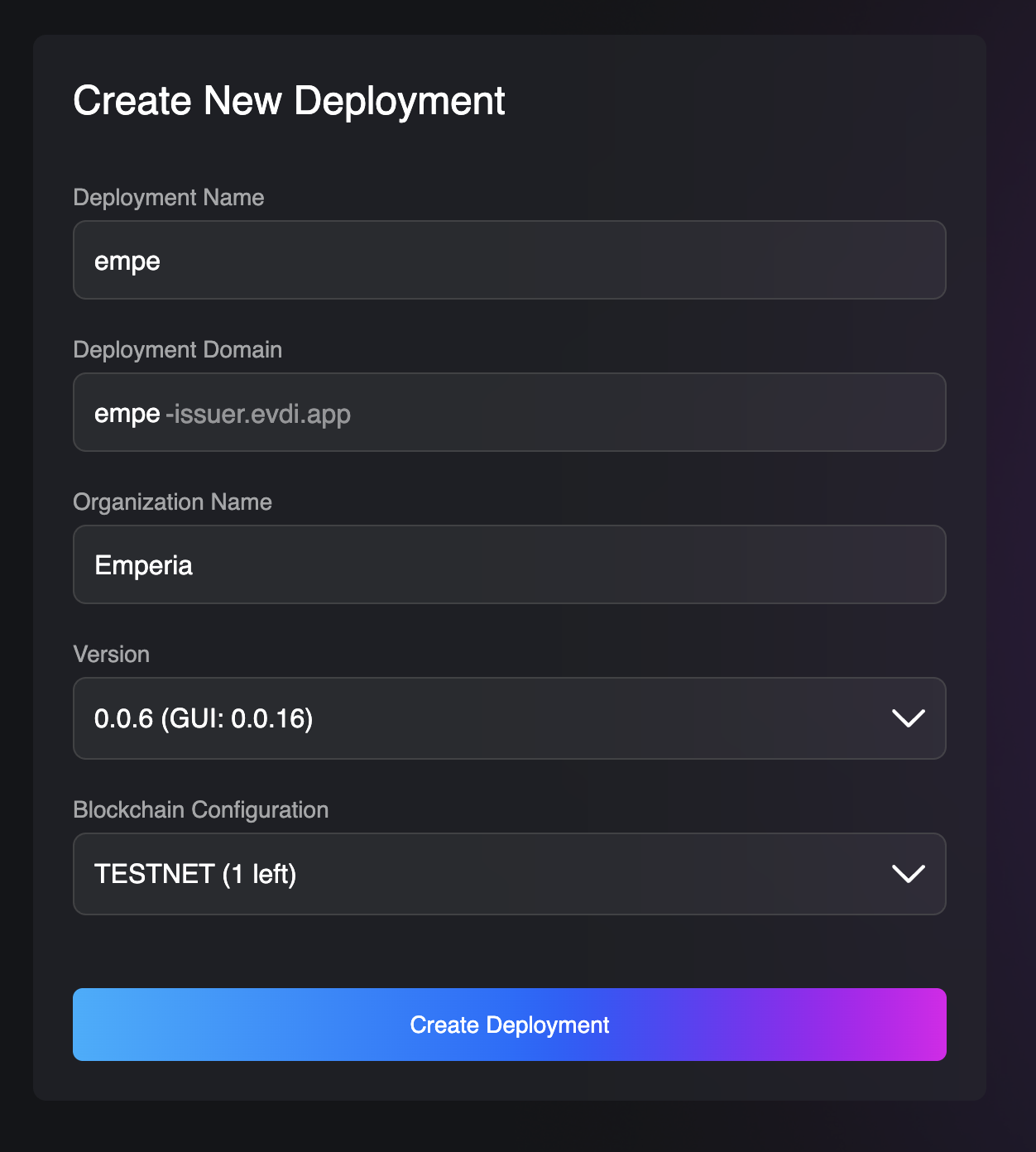
1. Click **New Deployment** to open the **Create New Deployment** form.
2. Fill in the form fields:
* **Deployment Name:** A short name for your deployment (visible only to you).
* **Deployment Domain:** The subdomain for your deployment, served under `evdi.app` — for example, `empe` becomes `empe-issuer.evdi.app`.
* **Organization Name:** The name of the organization responsible for this deployment.
* **Version:** Select the version you want to deploy.
* **Blockchain Configuration:** Select the network for your deployment — for example, **TESTNET**. *Note: Your deployment issues and verifies credentials using self-hosted DIDs and DID documents that the service creates and hosts for you.*
The Create New Deployment form
3. Click **Create Deployment** to complete the process.
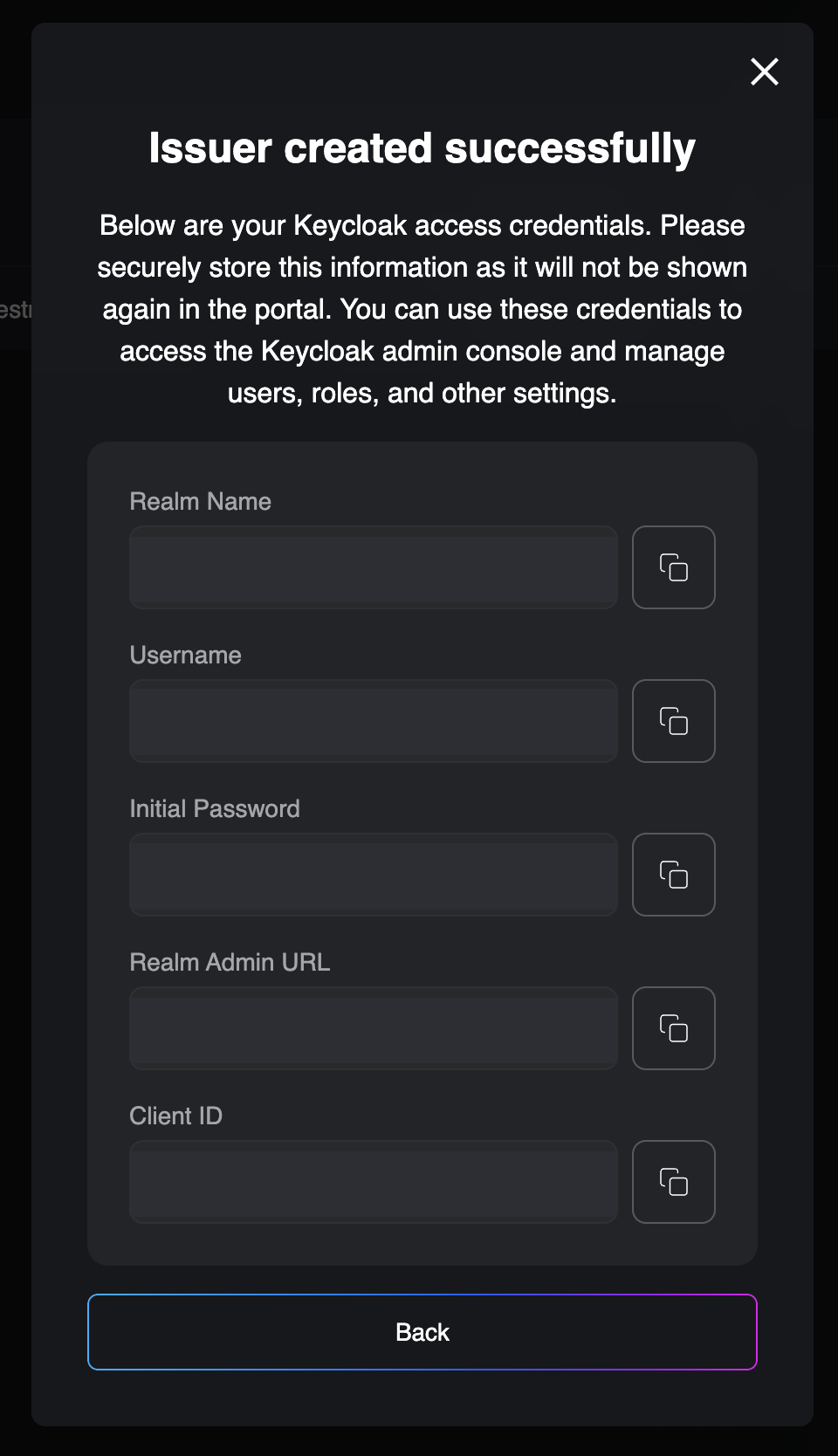
4. **Save your Keycloak access credentials.** The portal shows them **once** and does not display them again. They authenticate you to the deployment's identity provider (Keycloak):
* **Realm Name** — your deployment's Keycloak realm.
* **Username** and **Initial Password** — the realm admin account.
* **Realm Admin URL** — the Keycloak admin console for this realm.
* **Client ID** — the OIDC client your application uses.
You use these to obtain the OIDC **Bearer token** that your API requests carry (`Authorization: Bearer `) — see [Authenticating to Your Deployment](/develop/intro/authenticating-to-your-deployment.md). Store them like any admin secret; you can rotate them later from the Keycloak admin console (Realm Admin URL).
The Keycloak access credentials shown once after creation (values redacted here)
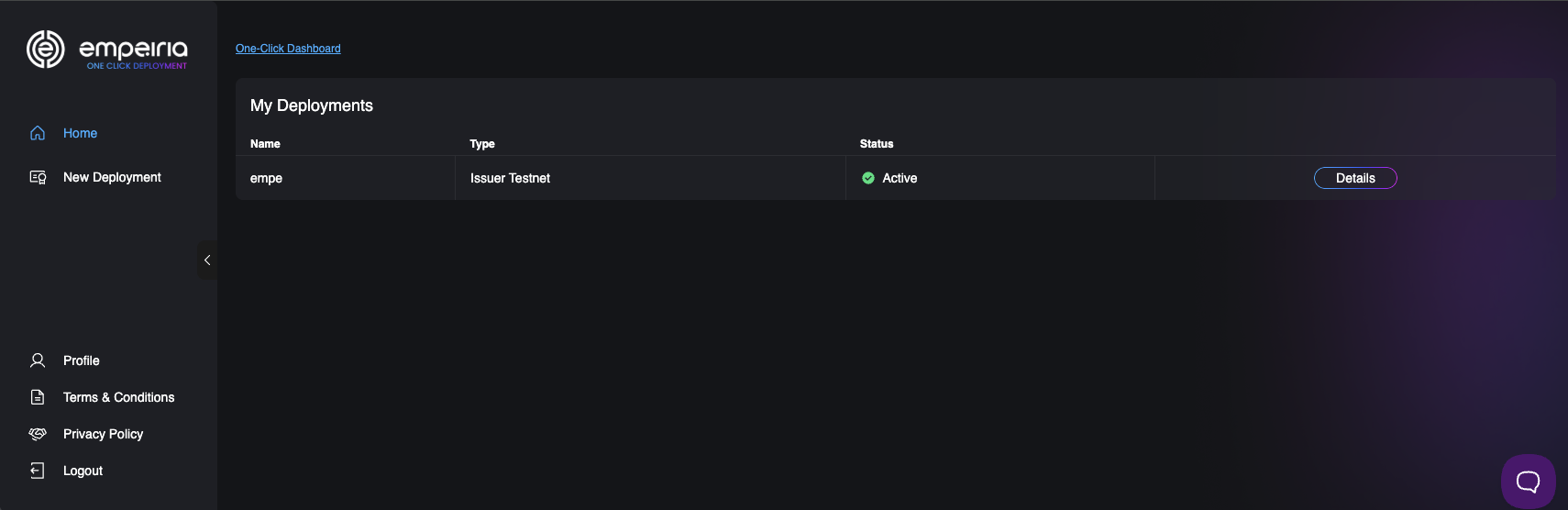
5. Wait until the deployment status changes to **Active**. Please note that it may take some time to activate. If an error occurs or the status does not change to "Active," please contact support for assistance.
6. Your deployment will appear in the **My Deployments** table once created.
The My Deployments table with a deployment in Active status
Once **Active**, the deployment exposes its API documentation and a self-hosted DID document — see the [Issuer Data Description](/develop/intro/issuer_data.md). From its detail tabs you can manage schemas and create credential offers.
---
# Agent Instructions
This documentation is published with GitBook. GitBook is the documentation platform designed so that both humans and AI agents can read, navigate, and reason over technical content effectively. Learn more at gitbook.com.
## Querying This Documentation
If you need additional information that is not directly available in this page, you can query the documentation by asking a question.
Perform an HTTP GET request on the following URL with the `ask` and `goal` query parameters:
```
GET https://docs.empe.io/develop/intro/create_issuer.md?ask=&goal=
```
`ask` is the immediate question: it should be specific, self-contained, and written in natural language.
`goal` is what the user is ultimately trying to achieve, the reason they need the answer. Sharing it helps GitBook give you a better, more relevant answer. A goal is most helpful when it describes the outcome the user wants rather than restating the question. For example, with `ask=how do I create an API token`, a goal like `automate deployments from our CI pipeline` lets GitBook tailor the answer to that use case.
The response will contain a direct answer to the question and relevant excerpts and sources from the documentation.
Use this mechanism when the answer is not explicitly present in the current page, you need clarification or additional context, or you want to retrieve related documentation sections.